Multi-modal Sensing for Additive Manufacturing
An array of novel sensing techniques to achieve intelligent process sensing and control for directed energy deposition.
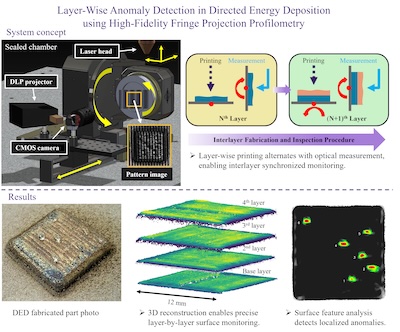
Additive manufacturing, particularly directed energy deposition (DED), is highly sensitive to process-induced instabilities that lead to geometric deviations, lack of fusion, and poor surface finish. These defects often originate and evolve layer by layer, making timely and quantitative in-situ sensing essential for ensuring part quality and enabling closed-loop process control. This project investigates multi-modal sensing strategies for additive manufacturing, with a focus on linking real-time process signatures to the evolving part geometry.
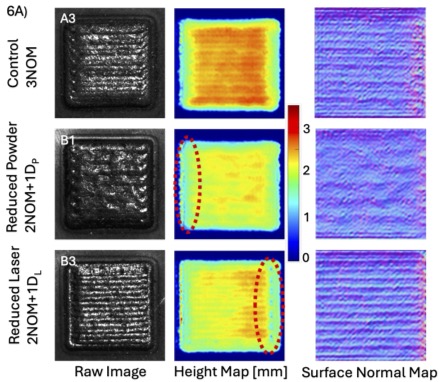
We develop a build-height–synchronized fringe projection profilometry system for in-situ, layer-wise 3D surface reconstruction during laser-based DED. The system achieves micrometer-scale accuracy and enables full-field measurement of surface morphology after each deposited layer without interrupting the manufacturing process. Based on the reconstructed surface point clouds, geometry-driven metrics including local point density and normal-change rate are introduced to automatically and annotation-free identify common deposition anomalies such as lack of fusion, under-deposition, and surface collapse. This approach shifts in-situ monitoring from indirect intensity- or thermal-based proxies to direct geometric evidence (Hu et al., 2026) (Hu et al., 2024).


References
2026
-
 Journal of Manufacturing Processes, 2026

2024
-
 Digital fringe projection for interlayer print defect characterization in directed energy depositionIn 2024 International Symposium on Flexible Automation , Jul 2024
